The AlaskaField Guide

Port Guide

Kenai Fishing Guide

The town at the mouth of Alaska's most heavily fished river.

The city of Kenai sits where the Kenai River empties into Cook Inlet, at the downstream end of a river ADF&G calls the most heavily fished in Alaska, averaging around 275,000 angler-days a year. The final 21 miles below the Soldotna bridge are the 'Lower River,' and the last 12 of those are tidal, the water that wraps around town.

The river's reputation was built on king salmon: the 97 lb 4 oz world-record rod-and-reel king came out of the Kenai in 1985. The present is harder, though. King runs have struggled, and ADF&G has closed the late-run king sport fishery by emergency order in recent seasons (in 2026, closed June 20–August 15, including catch-and-release). Today the dependable draws are the huge late run of sockeye in July, silvers from late July into fall, even-year pinks, and saltwater halibut trips on Cook Inlet.

Kenai works well as a base because it's road-connected, has its own commercial airport, and puts you within a short drive of both the lower-river bank fisheries and the charter fleet. Most of the town's operators are day-trip charters rather than lodges: river salmon one day, saltwater halibut the next.

When to Go

  • Mid-May – June: The season opens up. Early-run kings historically peaked in mid-June, but king fishing has been closed or heavily restricted by emergency order in recent years. Halibut charters start running as the weather settles.
  • July: The big month. Late-run sockeye enter the lower river in early July and peak in late July; in a good run, sonar counts can top 20,000 fish a day. July is also prime time on Cook Inlet for halibut, and the Alaska-resident-only dipnet fishery packs the beaches at the river mouth.
  • Late July – mid-August: Sockeye tail off, pinks flood in on even-numbered years (Cunningham Park in town is a good bet), and the first silvers arrive in late July.
  • August – September: Silvers are the main river target, with fish continuing to enter into early October. Saltwater trips keep running into fall, weather permitting.
  • Fall and shoulder season: Trophy rainbow trout and Dolly Varden fishing is upstream of town in the middle and upper river, often best in late fall after the salmon crowds leave. Special conservative tackle rules apply.

What You Can Catch

SpeciesPrime MonthsNotes
Sockeye (red) salmonJul–early AugThe workhorse run, averaging around a million fish total and peaking the last two weeks of July. Sockeye travel tight to the bank, so most fishing is from shore with weighted streamer flies drifted along the bottom. Don't wade too deep; the fish are often behind you.
King (Chinook) salmonMay–Jul (when open)Two runs, early (peak mid-June) and late (peak mid-to-late July). This is the river that produced the 97 lb 4 oz world record, but runs are down and recent emergency orders have closed king fishing outright: 2026's late-run closure ran June 20–August 15, including catch-and-release.
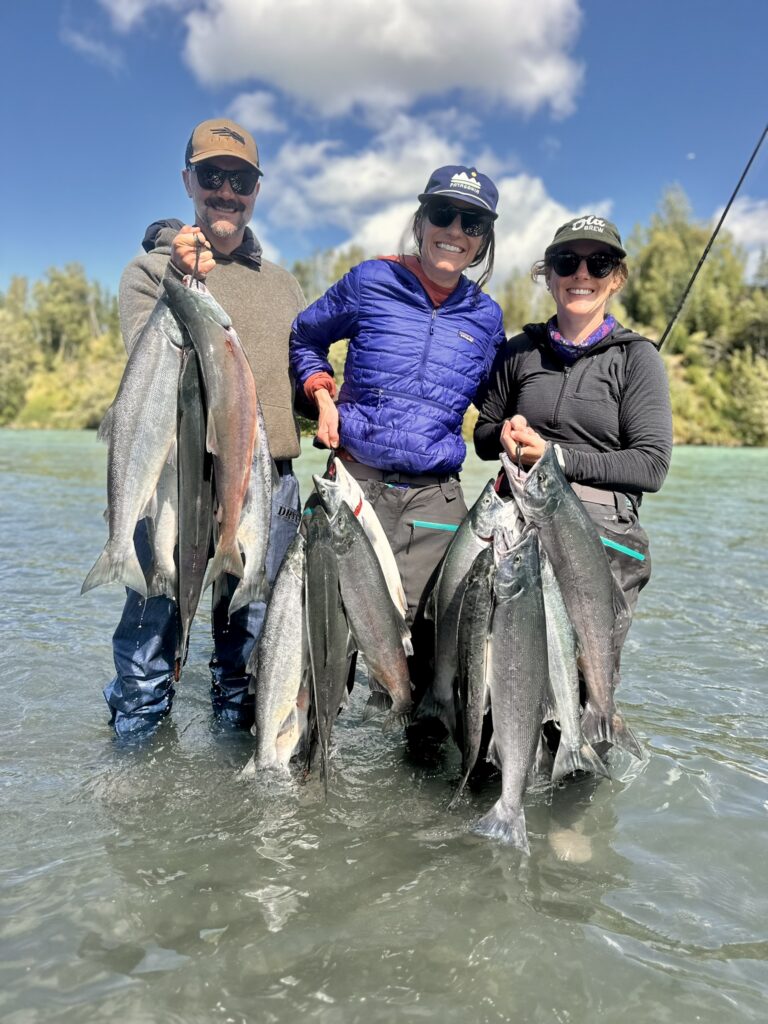
Coho (silver) salmonLate Jul–early OctArrive in waves from late July through early October; roughly 41,000 are taken by sport anglers in a typical year. Anglers anchor or tie off and fish roe (when permitted) or spinners; there's far more productive bank water for silvers than for kings.
Pink salmonLate Jul–mid-Aug, even yearsAbundant and aggressive on even-numbered years, and great for kids and light tackle. Most are caught downstream of the Soldotna bridge; Cunningham Park in Kenai is a proven spot. Excellent eating if caught fresh in the lower river and cooked right away.
Pacific halibutMid-May–OctCharters run onto Cook Inlet with peak fishing June through August. Size and bag rules for the charter fleet change annually under federal regulation.
Rockfish and lingcodSummerSome saltwater charters add rockfish or lingcod to halibut days depending on where they run. Lingcod has its own season and size rules.
Rainbow trout and Dolly VardenJun–Oct (best fall)The trophy rainbow water is upstream of town, from the Moose River up through Skilak and the upper river. About 95% of rainbows caught on the Kenai are released, and conservative tackle and season rules apply.

Seasons and limits change — always confirm current regulations with ADF&G before booking.

How Trips Work in Kenai

On the river, this is a guided-powerboat fishery: drifting, back-bouncing, and back-trolling plugs through the holes of the lower river, typically in 20-foot open boats running half-day or full-day trips. Kenai River guides must hold a commercial permit from the Alaska Department of Natural Resources, and ADF&G has found guided anglers are roughly twice as efficient as unguided ones on this river. Sockeye are the exception, largely a bank fishery anyone can do from public access points.

For saltwater, Kenai's charter operators run halibut trips on Cook Inlet, commonly full-day, with many outfits selling salmon-plus-halibut combo packages across two days. Boats supply rods and tackle; electric reels are not standard, so most anglers here crank halibut up by hand, and plenty prefer it that way.

Getting to Kenai

Kenai is one of the easier Alaska fishing towns to reach: about 158 road miles from Anchorage (roughly a 3-hour drive) via the Seward and Sterling Highways, through Cooper Landing and Soldotna. If you'd rather fly, Grant Aviation runs frequent daily commuter flights between Anchorage and Kenai Municipal Airport (about 30–40 minutes in the air), and rental cars are available in town. Public river access near town includes the beaches at the river mouth off South Spruce Street, Cunningham Park on Beaver Loop Road, and the Pillars boat launch on the Kenai Spur Highway.
Local Tips

  • Don't build a trip around Kenai kings without checking ADF&G emergency orders first. The late-run king fishery has been closed in recent seasons, and gear rules tighten fast when runs are weak.
  • The July dipnet fishery at the river mouth is personal-use, open to Alaska residents only. Visitors can't participate, but it's a spectacle worth seeing, and the city charges for parking and camping on the beach.
  • For sockeye, fish close to the bank. The fish run within a rod's length of shore, and casting far out just costs you fish and tangles.
  • Riverbanks here are protected habitat: stay on boardwalks and established trails, and expect some bank sections to be closed within 10 feet of the waterline in July and August.
  • Bring your own rain gear and waders. Charter boats and river guides don't provide it.
  • Buy your license and, if king fishing is open, a King Salmon Stamp before you hit the water; both are sold online and at local vendors.

Kenai FAQs

Can you still fish for king salmon on the Kenai River?

Sometimes, but don't count on it. King runs have been weak, and ADF&G has closed king fishing by emergency order in recent years; in 2026 the late-run closure ran June 20–August 15 with no catch-and-release.

When is the sockeye run in Kenai?

The late run enters the lower river in early July, peaks in late July, and wraps up by early-to-mid August. The peak itself usually lasts about 7–10 days. Timing shifts year to year.

Do I need a fishing license in Kenai?

Yes. Nonresident licenses are $30 for one day or $145 for an annual, and if you fish for kings (when open) you also need a King Salmon Stamp, which costs extra and is sold by duration.

Can visitors dipnet at the mouth of the Kenai River?

No. The famous July dipnet fishery is a personal-use fishery open only to Alaska residents. Visitors fish rod-and-reel under sport regulations instead, and the bank sockeye fishery is open to everyone with a license.

Are there halibut charters out of Kenai?

Yes. Local operators run halibut trips on Cook Inlet from mid-May into fall, with June–August the peak, and many pair a river salmon day with a halibut day.

More Kenai Guides

Operators in Kenai

All 17 Kenai listings →